Dog Tag
6.12.2025
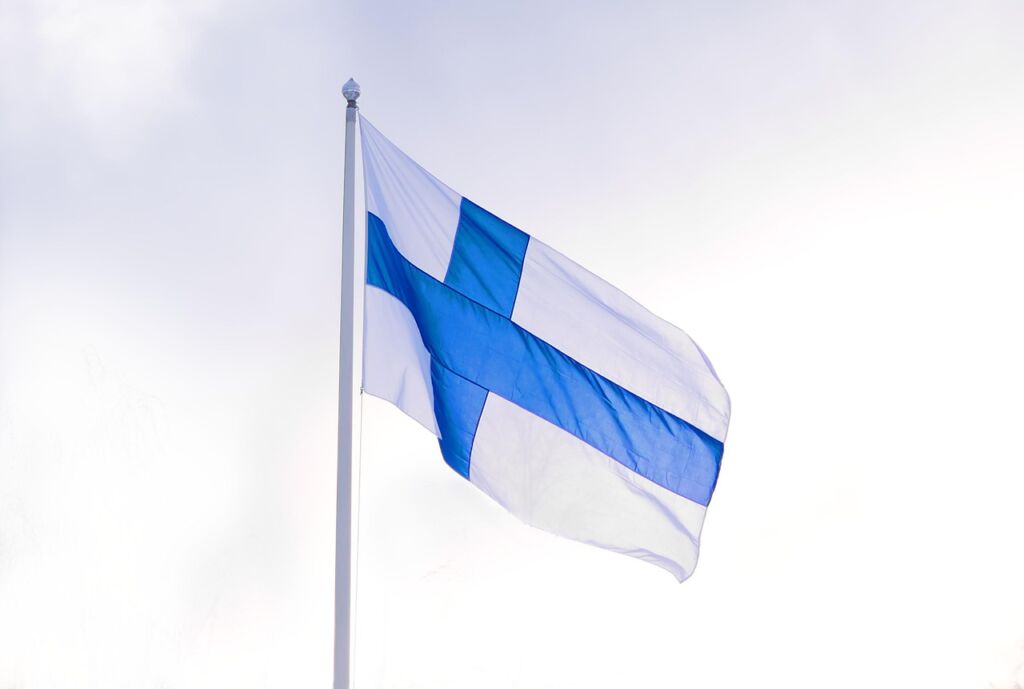
This Indepence Day has made me think about my grandfather. We go back to the fourth year of Continuation War; it is the month of May in the year 1944. A major Soviet attack is about to take place, but as yet, Finns know nothing about it.
My grandfather, serving as a military chaplain, is giving a sermon for the troops in Karhumäki. He speaks about the military identification tag or dog tag, a small yet significant object that everyone entering military service will receive. It is an object to be worn like a necklace. It consists of two parts with information about my identity and about that of the country I serve.
I borrowed this dog tag from my child, currently conscripted for national service. What the Finnish military officially call the object is different; what the object signifies is unchanged since 1944. Looking at the small object makes my heart ache. I find myself united with the cry of every mother on earth—in the words of Eeva Kilpi: “No, no, no! No war!”
Dog tag feels particularly relevant in these uncertain and restless times. During the war, dog tag was irreplaceably valuable. It meant it was possible to identify the fallen soldier. Through Winter War and Continuation War, Finns made sure that, if at all possible, soldiers fallen at the front were brought to their parishes of origin and given a proper funeral, with a war grave in the parish graveyard.
The importance of dog tag was not lost on my grandfather on that day when he spoke these words, broadcast from Karhumäki: “Receiving the dog tag implies possibility of death. For this reason, wearing it seems, initially at least, terrible. During Winter War, many soldiers sent their dog tag home, to be a keepsake for wife, bride, or some other relative. That was the easy way out.”
My grandfather then pointed out that apart from the visible dog tag, we also possess an invisible identity disk: the Christian’s dog tag. Not worn like a necklace, it has its proper place in our hearts. This dog tag also has two parts: “ ‘The Lord knows those who are his’, and, ‘Let everyone who calls on the name of the Lord turn away from wickedness.’ “ (2 Tim. 2.19)
The first of these two parts points out that every human person is known to God and endowed with dignity. The second one instructs us to live accordingly: to avoid what is wrong and to strive for what is right.
In all times and seasons, this foundation remains: a good conscience and striving for what is right. Patiently and consistently we must talk about peace and strive for it.
Dear friend, how does your dog tag look like? Or mine?
The philosophers of Classical Antiquity thought that “conscience” was an inner sense of right and wrong residing in every human person. Likewise, Lutherans have assumed that humanity possesses a deep-seated sense of how things ought to be.
However, conscience is not the sole property of Christians, or for that matter any religious believers. Any human person can make choices that are wise and morally well-founded. Luther puts it with characteristic acuity: “A wise but ungodly ruler is to be preferred to a devout but stupid one.”
Christians do find, though, that the human conscience is circumscribed by the Word of God. In his Sermon on the Mount, Jesus tells us: “In everything do to others as you would have them to do you; for this is the law and the prophets.” Mt 7.12
This Golden Rule unites us, irrespective of religion, upbringing, or cultural background. Conscience, therefore, is a thing common to all people. It is a shared sense of what is good and right.
Looking at the world makes it easy to wonder whether we have in fact lost our capacity for seeking what is good and right. Suffering in its several guises is not infrequently the result of human selfishness: nature destroyed, resources unequally shared, war waged in sundry places.
Our conscience rebukes us, individually and collectively. We are not mere onlookers.
Today’s Gospel, like my grandfather all those years ago in Karhumäki, wants us to know and believe that God knows his own. Jesus says, “I know my sheep, and they know me.”
We are, then, known by our God. This “knowing”, this recognition, we also seek in each other’s eyes. We desire to be seen as we most intimately are: as loving what we love, fearing what we fear, believing in what we believe in, manifesting in our lives that which is most important for us. When we are, even for a moment, made visible as our entire selves, heaven reaches down to earth.
Identity is so totally and profoundly in the heart of what it means to be human that any rejection of it is a source of excruciating pain.
Religion, together with language and ethnic background, is one of the chief building blocks of human identity. This makes it a power liable to abuse.
It is particularly dangerous to combine religious and ethnic identity in a way that excludes other people. Expressing this in so many words is important at a time when political religiosity as a phenomenon is waxing stronger. Christianity as well as other religions can and will be used as a tool for wielding power, for political aims. Examples of this dangerous development are clearly visible around the world.
Religion is used as a tool for weakening democracy. In the name of religion groups of people are depicted as enemies, individual lives are controlled and manipulated, the rights of women and minorities are jeopardised. This is not acceptable.
And yet everywhere and among followers of any and every religion we find people of conscience. People who wish to defend human dignity, equality, and peace. This is right and just and worth striving for.
Christian tradition and Finnishness are for many of us in this nation a most dear heritage; they are simultaneously true as our identities. Yet being Finnish is not coterminous with being Christian. Our national identity belongs to every Finn. A Christian identity, however, transcends national borders.
Followers of Jesus are not united by one sheep pen, but by one Shepherd. Our Independece Day Gospel has Jesus remind us that he has other sheep who are not of this fold. (Jn 10.16)
Jesus enjoys the company even of people we find difficult. Where we would rather avert our eyes, he makes his presence known.
The Gospel is a powerful current flowing freely, available for everyone. God’s love and care know no limits.
God becomes human so that we may find the way to each other. Jesus knows our wounded hearts, he hears when we silently cry to him. Those exhausted by the many adversities of life find that he does not abandon them. His words are full of love and charity, grace and mercy. He is the soul’s lovely guest; he is the light of human hearts; he is the healer of the wounded and broken.
Dear friends,
We have received innumerable good gifts. On this Independence Day we give thanks for a free and independent Finland. We give thanks for this beautiful country that is so dear to us; for its nature, for our language and culture, for freedom of thought and of religion; for previous generations, for our roots; for all Finns.
The important question for us today is: how can we strengthen peace and mutual trust, welfare and well-being, in today’s Finland—and all over the world?
St Paul gives us appropriate guidance: “Live in harmony with each other; do not be haughty, but associate with the lowly; do not claim to be wiser than you are. Do not repay anyone evil for evil, but take thought for what is noble in the sight of all. If it is possible, so far as it depends on you, live peaceably with all.” Rom. 12.16—18
In these words of St Paul we find an adequate description of the dog tag of humanity, the essence of our common humanity: do not fancy yourselves better than others; walk alongside those who have less; live in peace with all.
This dog tag has been given to all of us. Not just for the few; it belongs to everybody. Everybody needs care and nurture; everybody desires them. We all arrive and depart equally naked.
The other half of the human dog tag is this: what makes us recognisable? What are we like as humans, what is our footprint like? How have we answered the call to become builders of peace in love? This is what people will know us for.
Dear friends,
Jesus sends us to each other, different as we are and disagree as we may, to love each other, to bear the Christian dog tag.
He guides our steps to where there is longing, where there burdens of life are felt, and where human contact and community is sought. He sends us to the whole world, with its burdens and its joys, to give light to one another’s journey, but also to carry each other as necessary.
Our dear Finland calls for compassion and for a sense of us all being on the same side. Everyone ought to be able to trust that they will be supported when support is most needed. As Christians we are also called to promote peace, justice, and responsibility across national and generational borders.
Dear friend,
In this our celebration Jesus the Good Shepherd is in our midst. As demanding as the times may be, as exacting as your work may be, please do not forget that you also are carried and fed with good things by the Shepherd.
The Good Shepherd knows his sheep, will mend what is broken and take care of the exhausted. You are safe. The burden of your dog tag is not yours alone to bear. The Shepherd will carry you, pressed against his loving heart, and ask you: can you walk further again, now that I have carried you for a while?